Free Resources: Healthy Adult
This is a placeholder for the ‘Free Resources: Healthy Adult’ content. This section will be updated with actual content in the future.
This is a placeholder for the ‘Free Resources: Healthy Adult’ content. This section will be updated with actual content in the future.
These two models – Dialectical Behaviour Therapy and Schema Therapy – can compete against each other. We speak with Chris Hepworth, also known as nickname “Happy,” about his approach.
From day one, even as a Trainee therapist, he took an interest in these both DBT and Schema Therapy.
This honest discussion looks at how DBT can regulate clients but in Rob’s experience, leave them with a “core misery”, – which he acknowledges might be unique to him.
Chris Hayes raises questions about how – and when – to integrate the models.
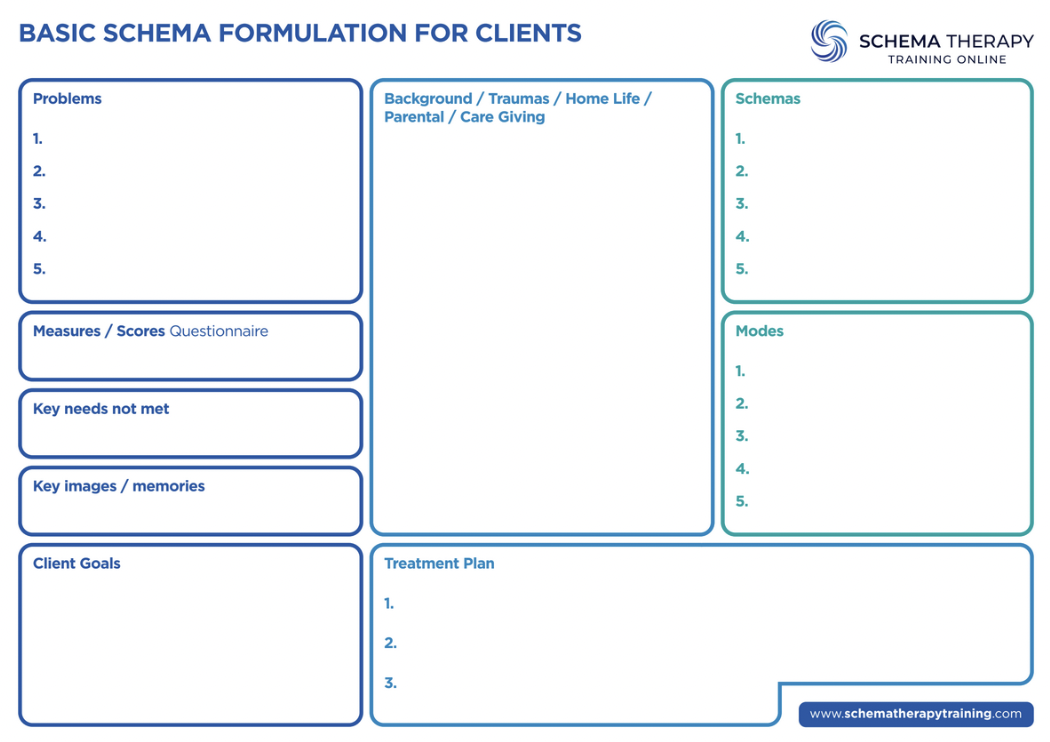
Free resource | New Schema Therapy Case Conceptualization Form – Approved by the International Society for Schema Therapy (ISST)
Recently, the ISST (this is the peak international body for schema therapy, and well worth joining;) released an updated Schema Therapy Case Conceptualization Form (Version 2.22) for those pursuing individual accreditation.
This form is great, and very detailed. If you have not used this form before, we highly recommend it, especially with patients who you may feel stuck with.
Going back and working on a detailed formulation usually uncovers some blind spots that could blow open the case.
You can download these below.
https://open.spotify.com/episode/3dOx5rHZCa2fQr8vfQee6f
Part 1 interview with the originator of schema therapy Dr. Jeffery Young, discussing developmental origins of schema therapy, schemas and modes, and the future of schema therapy.
Lead singer of a megadeath rockband or renowned schema therapy creator, Jeff Young dives into the origins of schema therapy.
Before developing his own therapy his main goal was to study as many different types of therapy as possible. Jeff always envisioned what the different methods to practice therapy should be; constantly striving to find the therapy that fits all and when there would be a close fit, there would always be one or more clients that didn’t quite fit the puzzle.
Starting therapy in his early 20s, Jeff’s mindset was very logic-driven and his devoted interests were to solve problems through logic, debates, and discussions. All in all, he concluded he was more in touch with logic than feelings at that age like many young men are. After decades of practice, he realized emotions are significant to his practice. “I was much more in touch with my mind than I was with my feelings.” Jeff stated, “The turning point was my recognition of how important emotions are to me as a person and also in doing therapy.”
Once he began his own practice he realized working with a diverse group of patients meant the practices he was using, for example, to treat depression, wasn’t the central problem anymore. Diverse groups mean diverse outcomes. There may be numerous issues such as personality disorders. So that was a light bulb moment… A new drive.
Chris and Rob discuss forensic schema therapy with Accredited Advanced Schema Therapist and Clinical Psychologist Dr. Lars Masden.
We have courses that are now eligible for CE Units (CEU).
What are CE Units?
A continuing education unit (CEU) or continuing education credit (CEC) is a measure used in continuing education programs to assist the professional to retain their license. In Australia, this is the equivalent of Continual Professional Development (CPD) points.
Why do CE Units matter?
This means our students practicing Schema Therapy in the United States can now complete this coursework and receive acknowledgment of CE Units from bodies who are accredited with CEUnits.com.
CEUnits.com® is the leading nationally accredited provider of continuing education for healthcare professionals in the United States.
They are nearing two decades and have delivered more than 50,000 courses to psychologists, social workers, addiction specialists and therapists.
Course 1 and Course 2 are both accredited for CE Units.
Simply complete the courses on this website and then visit CEUnits.com to take a test and claim your points.
Schema Therapy is a powerful evidence-based model of psychotherapy that is currently being disseminated across the globe.
Access to quality training in schema therapy has thus far however been largely limited to those that are privileged enough to live in locations where access is practically and economically possible.
That is, there is an obvious issue in terms of inclusion for therapists that come from countries where access to such training is not possible or cost-prohibitive. With this in mind, Schema Therapy Training Online is proud to announce a program for Developing Nations Scholarships that will open for application twice yearly for those who come from countries and/or practice contexts (e.g. working with Indigenous populations) where there is a disadvantage in terms of inclusivity or access to the dissemination of professional development.
Applicants must demonstrate via a short statement and a copy of their resume that they:
This is the second part of our interview with Dr Jeffrey Young. Here he discusses the role of the punitive critic, the effect of culture on schemas/mode development, and advice to the schema therapist in training.
“Learning is not just what people do to you. It’s observing people and internalizing how they think, how they feel, how they behave and [that] becomes part of us.” – Jeffrey Young
Since we are infants, the brain is constantly soaking up one’s environment in the early years through environmental and parental factors whether we are aware of it or not. Often we develop learned patterns and behaviors passed down from our parents whether positive or negative.
The critic, most of the time, does not serve a helpful function. One thing to point out is who is the punitive parent or punitive person in one’s life. The model is not that this is just an internalized critical voice but rather the internalized voice of ones own parent, sister, peer group or culture.
There is no question that the culture affects schema and if you don’t understand the relationship between the child and the parent in that culture and adapt to fit their need then these techniques couldn’t be used.
It’s arguably a part of the therapist’s role to get an understanding of a client’s culture, coming from an outside perspective.
Working with the local therapists is a massive resource to say. Feel free to collaborate and discuss schema and your schema training with someone who is an expert in their culture.
Diverse cultural parenting
The biggest difference among cultures, especially Eastern to Western, is the diverse parenting styles and the relationship between the child and the parents. When speaking to clients about a punitive parent, parents, it will have an effect when you try to question the way they were raised.
If there is resistance with asking about parenting style, consider asking through a series of questions about the parents and their parenting style. Possibly, ask to compare their parents with other parental styles of friends from the same culture. Then, by comparing with other parents in the same culture, they may or may not believe their parents are more punitive than others and will be more open to discussion after there is an understanding.
Whether or not clients have the wrong beliefs of how parents should treat their kids (wrong even within their own culture) challenging but not attacking those beliefs are important.
“I think we can, we can really help wellbeing in the world by, by helping parenting and getting that right.” – Rob Brockman