Blog

  • Schema Therapy Connect 2025: A One-Day Mini Conference for the Schema Community

    We’re thrilled to announce Schema Therapy Connect 2025—a one-day in-person mini conference bringing together clinicians, researchers, and practitioners from across Australia to connect, learn, and deepen their Schema Therapy practice.

    Whether you’re just starting your Schema Therapy journey or you’re an advanced-level therapist looking to sharpen your skills, this day is designed to offer practical, cutting-edge insights to take back to your clinical work.

    📅 Event Details

    Date & Time:
    Friday, November 7, 2025 | 9:00 AM – 5:00 PM

    Venue:
    Rydges Hotel
    28 Albion Street, Surry Hills, NSW 2010

    Ticket Prices:
    Early Bird: $179 (includes lunch & refreshments) – Available until August 1, 2025
    Standard Ticket: $229

    → Register and Pay Now


    Confirmed Presenters & Topics

    We’ve curated a diverse lineup of speakers addressing key clinical populations, practical techniques, and emerging areas in Schema Therapy:

    • Graham Kell (QLD)
      Not Just Small Adults: Adapting Schema Therapy for Adolescents
      Learn how to tailor your approach for younger clients with real-world strategies from an Advanced Child & Adolescent Schema Therapist.
    • Tena Davies (VIC)
      Chairwork to Increase Motivation for Change
      Bring your clients’ internal dialogues to life and break through stuck modes with powerful chairwork interventions.
    • Ben Callegari (VIC)
      Coming Out with Schema Therapy: Working With Gender and Sexual Diversity
      Explore affirming, schema-informed approaches to support LGBTQIA+ clients.
    • Sarah Dominguez (NSW)
      Integrating Imagery Rescripting to Boost Trauma-Informed Practice
      Strengthen your trauma work by deepening your use of imagery in safe and reparative ways.
    • Tracey Hunter (QLD)
      Identifying the Pathways for Positive Schema Development
      Focus not only on healing the past—but on actively cultivating new, healthy schemas.
    • Dr. Lars Madsen (QLD)
      Bulletproofing the Healthy Adult Mode: Limited Reparenting in High-Stakes Contexts
      Deepen your understanding of how to strengthen the Healthy Adult in complex therapeutic situations.
    • Liam Spicer (TAS)
      Understanding Early Maladaptive Schemas in Autistic and ADHD Individuals
      Shift the narrative and enhance your Schema Therapy practice with neurodivergent clients.

    Why Attend?

    • Get face-to-face learning with Australia’s leading Schema Therapists
    • Expand your toolbox with practical, evidence-informed techniques
    • Connect with like-minded clinicians from across the country
    • Walk away feeling re-energised, skilled-up, and ready to integrate

    Spots are limited, and Early Bird pricing ends August 1, 2025—so don’t wait to secure your place.

    → Register  courses.schematherapytrainingonline.com/p/connect2025
  • Responding to ‘But that Wasn’t Real!!!’ client feedback

    If you use imagery rescripting in your Schema Therapy practice, you’ve likely heard a client say something like:

    “But that didn’t really happen. That’s not real.”

    It’s a powerful moment—one that can derail the session or open the door to meaningful emotional healing, depending on how we respond.

    In this blog, we’ll walk through a step-by-step framework you can use to respond compassionately and effectively when clients push back on the emotional reality of imagery work. You’ll also find sample language, an optional metaphor, and a full therapist transcript to help you ground this in your own voice.

    Download the Free Resource here.


    Why Clients Resist Imagery

    Clients often come out of a rescripting experience with deep emotions—and sometimes, deep confusion. They may intellectually understand the exercise, but emotionally, it can feel jarring:

    • “It’s not what happened.”
    • “You weren’t there.”
    • “That’s a lie.”

    These responses aren’t wrong. They’re protective. And they’re invitations to slow down and help the client integrate what just happened.


    A Step-by-Step Framework to Respond

    1. Validate the Client’s Reality
    Start by acknowledging the truth in their observation.

    “You’re right. That didn’t happen in real life. It’s completely valid to say that.”

    2. Acknowledge the Limits of Therapy
    Be honest and clear: therapy doesn’t rewrite history.

    “Nothing we do here can change what actually happened to you.”

    3. Reframe the Aim of Imagery Rescripting
    Shift the focus from facts to emotional repair.

    “The goal isn’t to change the past. It’s to help that younger part of you feel safe, seen, and less alone—now.”

    4. Link Present-Day Struggles to the Past
    Use mode language to connect their present distress to unresolved childhood trauma.

    “Even now, little Jenny still feels scared when she’s on a train or in a crowd.”

    5. Justify the Use of Imagery
    Normalize imagination as a therapeutic tool.

    “We’re using imagery to give that younger part something she never got: protection, care, validation.”

    6. Emphasize Emotional Learning
    Help the client understand that while history can’t change, emotional responses can.

    “We’re not rewriting facts—we’re changing how those memories feel.”

    7. Invite Reflection and Integration
    Ask what part of the experience (if any) felt soothing or meaningful.

    “Did any part of you feel even a little comforted during that?”

    8. If Resistance Continues – Look for a Coping Mode
    Persistent resistance may indicate a blocking mode at play. You’ll need to engage with that mode before continuing with imagery work.


    Optional Metaphor: The Broccoli Analogy

    Some clients benefit from metaphor to make sense of emotional dissonance:

    “It’s like trying broccoli for the first time when you’re used to eating chips. It feels weird—but it might be what your body actually needs.”


    Sample Therapist Language

    Here’s a full sample response you might adapt in-session:

    “Okay, Jenny… I think I need to apologize. When you say, ‘That’s not real,’ I wonder if I haven’t explained this well enough. Because you’re absolutely right—what we did in imagery didn’t happen in real life. Nothing we do here can change that history, and I want to honour what you went through.”

    “This exercise isn’t about pretending it didn’t happen or rewriting your story. It’s about helping little Jenny—the part of you still carrying the fear and pain—realize she’s no longer alone. We can’t change the facts, but we can work on how those facts live in your body. That’s what we’re doing here.”

    “We’re helping her feel seen. Safe. Protected. And that’s what starts to shift how these memories affect you today.”


    Free Resource Download: Imagery Rescripting

    Imagery rescripting can be one of the most healing interventions in Schema Therapy—but only if clients feel safe and understood throughout the process.

    When a client says, “But that wasn’t real,” it’s not a failure. It’s a moment of truth. With the right response, it can be the very turning point that helps them take the work deeper.

    Download the free resource.

    We hope this framework supports you in navigating those moments with confidence, compassion, and clinical clarity.

    Want more tools like this?
    Explore our full training library at SchemaTherapyTrainingOnline.com.


    © Chris Hayes & Rob Brockman, 2024
    You’re welcome to share this article with colleagues—please credit the original source.

  • New Overcompensation Mode Variants

    New Overcompensation Mode Variants

    In this episode Robert Brockman and Chris Hayes discuss the variants of the Overcompensation Mode.

    These are written about by David John Arthur Edwards in a paper available here: https://www.frontiersin.org/articles/10.3389/fpsyg.2021.763670/full

    The paper discusses various overcompensation modes in the context of schema therapy, focusing on how these modes reflect certain coping strategies. One such mode is the Pollyanna Overcompensator, characterized by an overly optimistic and sometimes unrealistic outlook as a way of coping with underlying issues. This mode, like others in the overcompensation category, represents a psychological mechanism where individuals adopt certain behaviors or attitudes to manage or mitigate deeper, often unaddressed emotional or psychological challenges.

  • Schema Therapy and Voice Hearing: A Conversation with Dr Georgie Paulik White

    Dr Georgie Paulik White, an associate professor of clinical psychology and the visionary behind the Perth Voices Clinic. Georgie specializes in working with individuals who hear voices—a phenomenon often associated with complex trauma histories. Through her groundbreaking research, she has adapted schema therapy techniques, especially imagery rescripting, to effectively help voice hearers heal and improve their quality of life.

    Diving Deep into Schema Therapy and Voice Hearing

    Last week we interviewed Georgie about her work. We delved into the fascinating and crucial intersection of schema therapy and voice hearing. Many individuals who hear voices have complex trauma histories, and Georgie’s groundbreaking work focuses on using imagery rescripting techniques to help them heal.

    Imagery Rescripting: Adapting Techniques for Complex Trauma

    One of the most enlightening parts of our discussion was how traditional imagery rescripting can be modified to safely and effectively assist clients who hear voices. Georgie shared how even within the constraints of limited session numbers, significant progress can be made. This is especially important considering the challenges many therapists face with session limitations.

    Addressing the “Too Hard” Cases

    We also tackled the topic of working with clients who might seem \”too hard\” to reach. Georgie’s insights into how schema therapy can be applied to these individuals were truly inspiring. It’s a reminder that with the right approach and understanding, we can make a meaningful impact on even the most challenging cases.

    Why You Should Tune In

    If you’ve ever wondered about the intersection of voice hearing, trauma, and schema therapy—or how to work with clients who might seem beyond reach—this episode is a must-listen. Georgie’s energy and expertise are both infectious and enlightening, and I left our conversation feeling invigorated about the possibilities for clinical practice.

  • Schema Therapy: Fresh learnings in 2024

    Schema Therapy is continually advancing with new ideas and techniques, making continuous learning essential for therapists seeking to enhance their practice. The latest episode of "What's the Schemata," titled "45: Fresh Learnings for 2024," dives into the transformative power of learning. This episode offers a rich mix of reflections and insights from recent workshops, providing practical advice for therapists committed to professional growth.

    Schema Therapy supervisors Chris Hayes and Rob Brockman share their experiences from their semi-annual retreat in Bali. During the retreat, they spent a week immersed in intensive training and knowledge exchange. Three outstanding presenters introduced fresh ideas and nuanced approaches to Schema Therapy, significantly influencing Hayes' and Brockman's practice over the past year. They emphasize the importance of integrating new concepts and refining established techniques.

    One of the key themes in this episode is the role of the healthy adult mode in Schema Therapy. Hayes and Brockman highlight how engaging the client's healthy adult mode effectively responds to vulnerabilities and coping mechanisms. They share examples of dialogues between the vulnerable child and healthy adult that foster self-trust and resilience in clients.

    The episode also explores the concept of empathic confrontation, a technique that balances empathy and confrontation to help clients address maladaptive behaviors. The discussion underscores the importance of tailoring this approach to the client's level of activation, ensuring that interventions remain both supportive and effective.

    Reflecting on their experiences at the recent ISST conference in Warsaw, Hayes and Brockman discuss the use of somatic resourcing in Schema Therapy. They emphasize the power of physical posturing, self-soothing techniques, and grounding exercises to enhance the therapeutic process and support clients in managing distress.

    This episode of "What's the Schemata" highlights how learning transforms therapeutic practice. By continuously seeking new knowledge and refining techniques, therapists can better support their clients in their journey towards healing and growth. Hayes' and Brockman's insights and practical advice provide valuable guidance for therapists looking to elevate their Schema Therapy practice.

  • Dr Andrew Phipps on Play and Happy Child Mode

    Dr Andrew Phipps on Play and Happy Child Mode

    Dr Andrew Phipps, known as Dr Happy, shares his journey to Schema Therapy and explores the vital role of play in therapy.

    In conversation with Chris Hayes and Robert Brockman, Dr Andrew delves into how play can be used to frame, understand, and strategize with clients. His insights into the play literature and working with different clients offer valuable perspectives for practitioners.

    “Getting into the play literature and figuring out how to work with clients to understand how to work with different clients was really interesting,” says Dr Andrew.

    A particularly compelling insight from Dr Andrew highlights the connection between play and self-discovery:

    “If you don’t know who you like, how can you know who you are?”

    Dr Andrew explains how allowing ourselves to access Happy Child Mode by entering the play state enables us to access joyful states, providing a unique perspective on therapeutic growth.

  • New Research: Efficacy of Imagery Rescripting

    New Research: Efficacy of Imagery Rescripting

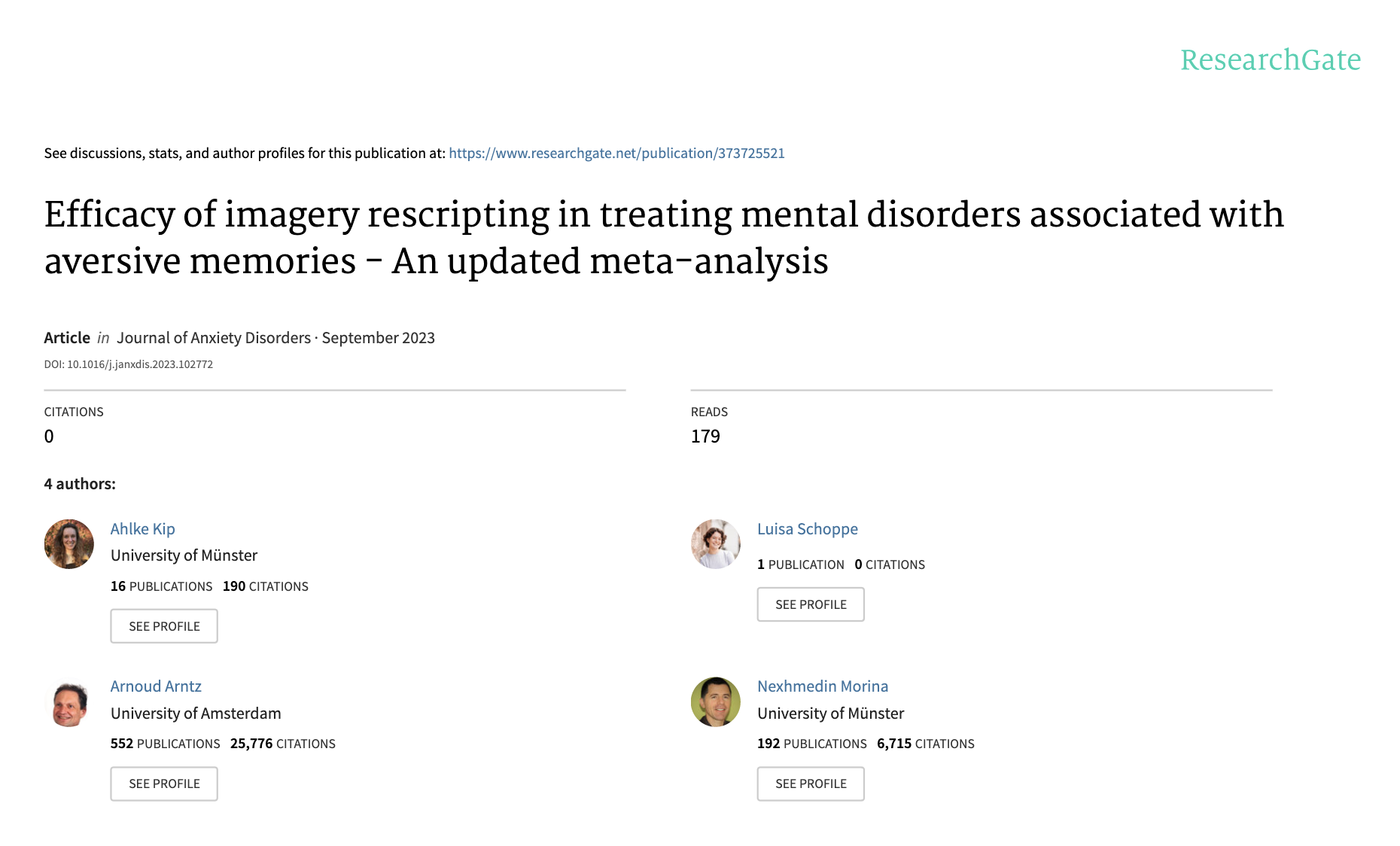
    Efficacy of imagery rescripting research paper from ResearchGate

    What is ImRs?

    Imagine being able to not only revisit and confront distressing memories but to also reshape their course in a way that satisfies your present basic needs. This is precisely what ImRs aims to accomplish.

    ImRs represents a significant breakthrough in the field of mental health, offering a means to transform the meaning associated with powerful aversive memories. The impact of such memories extends far beyond the past, as they influence our current and future behavior, playing a pivotal role in the development and persistence of various mental disorders. Whether we consider adverse childhood experiences or the challenges of adulthood, the way we process and represent these events can lead to intrusive memories, avoidance behaviors, and dysfunctional memory appraisals, all contributing to the maintenance of psychological symptoms.

    This approach holds relevance not only for conditions like posttraumatic stress disorder (PTSD) but also for a range of other disorders, including depression and social anxiety disorder. The foundation of ImRs lies in the reconsolidation hypothesis, which suggests that previously consolidated memories can be brought back into an active state, allowing for the reinforcement, reduction, or update of their content and associated emotions. It’s important to note that ImRs doesn’t involve replacing original memories with false ones but rather focuses on creating more functional meanings.

    The impact of ImRs extends to reducing negative self-beliefs and enhancing feelings of mastery and self-efficacy, bringing about a positive transformation in one’s emotional landscape. This versatile technique can be applied either as a stand-alone intervention or in combination with other treatments, seamlessly integrating into various cognitive behavioral therapies and schema therapy.

    Two distinct approaches to ImRs have emerged, one involving cognitive preparation to challenge dysfunctional interpretations of traumatic memories and the other emphasizing the experiential aspect, where the new script is based on spontaneous needs and action tendencies during the imagery. Surprisingly, there has been no direct comparison of these two approaches, leaving room for exploration.

    While several trials have explored the efficacy of ImRs in treating various mental disorders, a comprehensive meta-analysis is needed to provide a clearer picture of its impact. With a growing body of research in this field, we aim to conduct an updated meta-analysis, focusing on randomized controlled trials (RCTs) to assess the effectiveness of ImRs compared to control conditions or other psychological treatments. By doing so, we hope to shed light on the true potential of ImRs in reducing psychological complaints and improving mental well-being.

  • Suicide and Schema Therapy

    Suicide and Schema Therapy

    By Robert Brockman

    Jenny looks up at me… slightly teary… but now with a more determined, even steely look in her eye.

    “Well, if I can’t escape this pain … then I guess I’ll have to kill myself… there’s no point being here…”

    Most schema therapists will know what it’s like to work with clients like Jenny who are at the end of their tether in trying to cope with their ’emotional pain’. Most of us don’t escape living without some form of emotional pain, but for many clients, especially those with problems managing suicidal impulses, this emotional pain can feel more than they can tolerate.

    Therapists can of course feel the weight of trying to help someone find a way through their (emotional) pain towards a life worth living. This week is Suicide Awareness Week, and it got me thinking about a question often asked at Schema Therapy training events…

    What about Schema Therapy and Suicide?

    Understanding such pain and the dynamics of disclosing suicidal ideation can be complex and varied from person to person. However, such behaviour can be interpreted through the schema mode lens. Clients like this, in referring to their ‘pain’, are referring to parts of themselves – modes – that hold the trauma and schemas that, when activated, are experienced as distressing and emotionally overwhelming – ‘painful’.

    When suicidal behaviours are present, it may be helpful for the Schema Therapist to consider one or more of the following modes involved in inciting the client to harm themselves.

    Common Modes in Suicidal Behavior

    Vulnerable Child > Helpless Surrenderer: At the centre of a suicidal “headspace” is the vulnerable child mode. Here, the client may feel a profound helplessness and hopelessness towards their pain and emotional suffering. “I can’t cope/ do anything”.

    Vulnerable Child > Connection Seeker: A drive for connection-seeking drives the client towards seeking help and connection from others to distract or regulate the pain. The client’s core need for attention and care is evident, but in this Mode, the client is unable to seek connection and support in healthy ways.

    Punitive Inner Critic: So often driving the emotional pain alongside the vulnerable child the punitive critic kills off any remaining hope or energy for change “no-one could ever love you anyway…”

    Angry Child Mode: Here, the client feels a deep resentment and anger towards others around them and their predicament: “screw this life”. Such deep frustration can increase risk, with the client spiralling towards impulsively acting on such notions.

    Self-Soother Mode: Tempts clients to act compulsively to distance themselves from the pain. It tends to often be more superficial in nature (e.g. non-suicidal self-injury, cutting, etc.) but can be dangerous in terms of the level of impulsivity.

    The Detached Protector: A client in this Mode operates in an emotionally detached and numb way, fixating on the option of “ending it”. They may take an extremely pragmatic and remote view of the circumstances at hand and numb the meaning and importance of intimate relationships of others around them.

    Compliant Surrenderer: Clients who struggle with suicidal ideation coming from this Mode are always a concern. They may say, “I need to do this for my loved ones because I am such a burden”. This kind of thing is always gut-wrenching to hear – that they feel their loved ones would be better off.

    The difficulty with therapy is that we seek to lead our clients through their emotional pain. Our aims are to heal and assist them in getting their core emotional needs met. We may ultimately be teaching a better way to manage and regulate emotions – their pain. But this means getting them on board and convincing their coping modes to give therapy a shot. Ultimately, we have to balance the risk of ‘going there’ (in therapy) with the risk of not.

  • Episode 3: Schema Therapy Hacks – All Roads Lead to the Critic

    Episode 3: Schema Therapy Hacks – All Roads Lead to the Critic

    Improve Your Schema Therapy Practice with these Brief 10-Minute Clips from Chris and Rob

    In this brief video clip, Chris and Rob describe how to efficiently develop a coherent treatment plan – or what we call treatment ‘objectives’. Rob discusses the effectiveness of focusing on the critic mode early in treatment.

    Synopsis

    Once you have completed a mode map with a client, the next thing they will often ask is ‘what next?’ This episode provides practical guidance on developing effective treatment objectives, with a special focus on addressing the critic mode early in therapy.

  • Schema Therapy Based Coaching: Is Schema Therapy for Everyone?

    Schema Therapy Based Coaching: Is Schema Therapy for Everyone?

    By Dr Robert Brockman

    This month I had the pleasure of reading this chapter from a new edited book on Third Wave Approaches to ‘Coaching’.

    McCormick, I. A. (2022). Schema Coaching: Theory, research and practice. In Passmore, J & Leach, S (eds), Third Wave Cognitive Behavioural Coaching: Contextual, Behavioural and Neuroscience Approaches for Evidence-based Coaches. Pavilion Publishing and Media Ltd, Shoreham-by-Sea.

    In reading it I was immediately struck by something that has been obvious to me for a long time now. Schema Therapy is probably for everyone. Ok maybe an overstatement but let me explain. What I mean by that is that it is a bit of a misnomer to think of the schema model as only applying to ‘complex cases’ or ‘personality disorders’ – rather Schema Therapy is for personalities. For example, in working with psychologists in supervision, it is clear that the model applies just as well to the struggles of busy professionals as it does to the ‘pointy end’ of mental health. The more we use this model as a lens, the more you see applications of the model in very diverse settings.

    So, this month we sat with Dr Iain McCormick to discuss his chapter and the application of Schema Therapy in the executive coaching, corporate and high-performance contexts. Resources articles posted for download below (referenced in the podcast).

    We hope you enjoy the discussion and resources.

    Chris Hayes and Rob Brockman

    Coaching Article 1

    Coaching Article 2

    Coaching Article 3

    Coaching Article 4